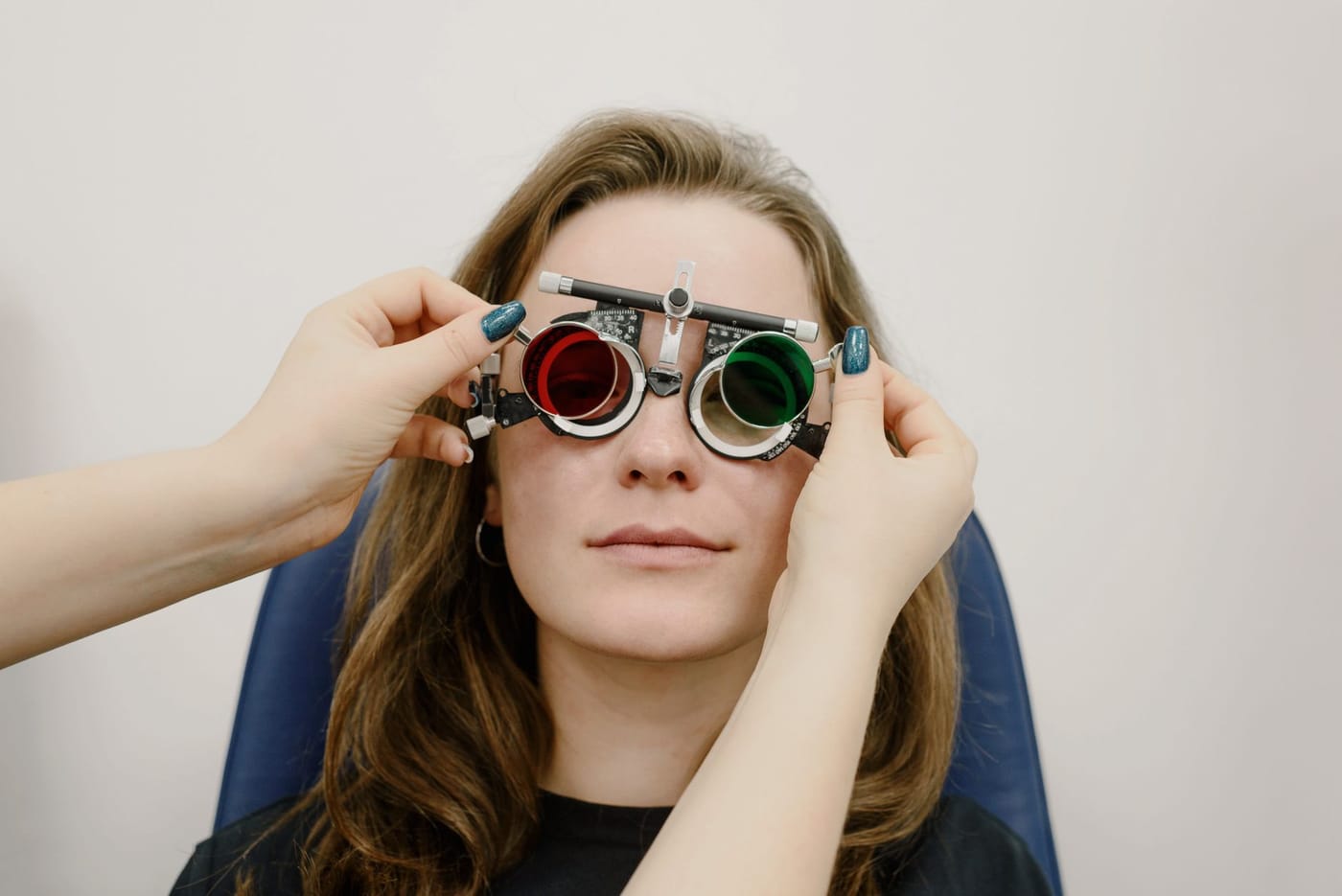
What Tests Are Done During a Complete Eye Exam?
A complete eye exam includes checking your visual acuity (the eye chart), measuring your refraction for glasses, testing your pupils and eye movements, and checking eye pressure. It also involves a slit-lamp examination of the front of the eye and, after dilation, a detailed look at the lens, optic nerve, and retina. Depending on your history and findings, imaging such as OCT, visual field testing, corneal topography, or retinal photography may be added.
Key Takeaways
- Visual acuity: reading the chart to measure how sharply each eye sees.
- Refraction: fine-tuning the lens power for your glasses or contacts prescription.
- Pupil and eye-movement testing: checking nerve function and alignment.
- Eye pressure (tonometry): part of screening for glaucoma.
- Slit-lamp exam: a magnified look at the eyelids, cornea, and lens.
- Dilated retinal exam: the key step for evaluating the optic nerve and retina, sometimes with OCT, visual fields, or photography.
Why Patients Ask This Question
People often picture an eye exam as just reading a chart and picking out glasses, so they are surprised to learn how much more it involves. Patients want to know what will actually happen, how long it will take, and whether anything will be uncomfortable. Understanding the parts of the exam also reassures them that the visit checks eye health, not just their prescription.
What This Means for Your Eyes
Each test looks at a different layer of the visual system. The chart and refraction measure how well the eye focuses; pupil, movement, and pressure tests check nerve function and the risk of glaucoma; and the slit lamp and dilated exam evaluate the actual tissues of the eye from front to back.
Together they build a full picture of both how you see and how healthy your eyes are. That is why a complete exam can catch disease that a simple vision screening would miss entirely.
Detailed Explanation
A complete exam usually begins with your history and a check of visual acuity, one eye at a time, using the familiar chart. Refraction follows, either with a phoropter ("which is better, one or two?") or automated tools, to determine your best-corrected vision and prescription. The doctor tests how your pupils react to light and how your eyes move and align, which reflects the health of the nerves controlling them.
Eye pressure is measured by tonometry, an important screen for glaucoma. At the slit lamp, a microscope with a bright, adjustable beam, the doctor examines the eyelids, conjunctiva, cornea, front chamber, and lens in fine detail, often using a dye to reveal dryness or surface damage. Dilating drops then widen the pupils so the lens, optic nerve, macula, and peripheral retina can be inspected thoroughly.
Not every patient needs every test. Based on your risk factors and what the exam shows, the doctor may add OCT to image the retina and optic nerve in cross-section, a visual field test to map your side vision, corneal topography to map the cornea's shape, or photographs to document findings over time. The goal is a complete, individualized evaluation rather than a fixed checklist.
When This May Be Serious
The exam becomes urgent, rather than routine, when it is prompted by warning signs. Sudden vision loss, a new curtain or shadow, new flashes or a burst of floaters, severe eye pain, or new double vision should be examined right away rather than scheduled as a routine check. If an exam is being done to investigate such symptoms, dilation and additional imaging are especially important, and any finding of a retinal tear, detachment, or acute optic-nerve problem calls for prompt treatment.
How an Ophthalmologist Evaluates This
The ophthalmologist assembles these tests into a logical sequence guided by your history. Acuity and refraction quantify your vision, pupil and motility testing screen the nerves, tonometry and optic-nerve assessment address glaucoma risk, and the dilated retinal exam evaluates the back of the eye. When something looks abnormal, targeted testing follows, such as OCT for macular or optic-nerve detail, visual fields for glaucoma or neurologic loss, or topography for corneal shape. Each added test answers a specific question rather than being done reflexively.
Treatment Options
The exam itself is diagnostic, so "treatment" means acting on what it finds. That might be a new glasses or contact-lens prescription, artificial tears for dry eye, monitoring a stable finding, pressure-lowering drops for glaucoma, or referral for a retinal or corneal condition. If imaging or the dilated exam uncovers disease, the doctor discusses the specific options for that problem. The value of the complete exam is that treatment is based on a clear diagnosis rather than a guess.
What You Should Not Do
- Do not assume a quick vision screening equals a complete medical eye exam; they check very different things.
- Do not decline dilation or recommended imaging when your doctor advises it to evaluate the retina or optic nerve.
- Do not skip mentioning your medical history, medications, or symptoms; they guide which tests are needed.
- Do not expect glasses alone to reveal eye disease; the health checks are what catch silent problems.
- Do not put off the exam because your vision feels fine, especially if you are overdue or at higher risk.
When to Call May Eye Care Center
Call to schedule a complete eye exam if you are due for a checkup, your vision is changing, or you have risk factors like diabetes or a family history of eye disease. Patients throughout the Hanover area can have a full evaluation that includes the tests appropriate for them. If you have sudden vision loss, severe pain, flashes, floaters, or an injury, seek urgent care rather than booking a routine visit.
Bottom Line
A complete eye exam combines vision and refraction with pressure, slit-lamp, and dilated retinal checks, adding targeted imaging as needed, so both your sight and your eye health are evaluated. May Eye Care Center tailors the testing to what your eyes actually need.
Frequently asked questions
01Can an eye exam find glaucoma, diabetes, or retina problems?
Yes. A complete eye exam evaluates the optic nerve, eye pressure, and retina, and it can detect blood-vessel changes that may reflect systemic conditions such as diabetes or high blood pressure. Many serious eye diseases, including glaucoma, diabetic retinopathy, macular degeneration, and some retinal conditions, begin silently, which is why an exam matters even when nothing feels wrong.
This page also answers
- How often should adults have a dilated eye exam?
- What does an ophthalmologist check during an eye exam?
- Can an eye exam find glaucoma, diabetes, or retina problems?
- Do I need an eye exam if I see 20/20?
- When should I schedule a medical eye exam in Hanover PA?
- When should this be checked urgently?
- What testing helps confirm the diagnosis?
- What treatments are available?
- What should patients avoid doing at home?
Medical sources
- aao.org/eye-health/tips-prevention/eye-exams-101
- nei.nih.gov/eye-health-information/healthy-vision/finding-eye-doctor/get-dilated-eye-exam
- nei.nih.gov/eye-health-information/healthy-vision
This article is for educational purposes only and is not a diagnosis, treatment plan, or substitute for an eye examination by a qualified eye doctor. Eye symptoms can have many causes, and some problems can threaten vision if they are not treated promptly. Do not diagnose or treat yourself based only on online information. If you have eye pain, sudden vision loss, flashes, new floaters, a curtain or shadow in your vision, double vision, chemical exposure, trauma, severe redness, light sensitivity, or any concerning eye symptom, seek urgent medical eye care or emergency care.
Schedule your eye exam at May Eye Care Center in Hanover, PA
Serving York, Gettysburg, Adams County, and northern Maryland (driving distances). Call (717) 637-1919 or explore more about eye exam & vision at our practice.
Call (717) 637-1919