What surgery treats Fuchs' dystrophy?
When Fuchs’ dystrophy causes persistent swelling and blurred vision, the modern treatment is endothelial keratoplasty — replacing only the cornea’s thin inner pump layer rather than the whole cornea. DMEK (and the closely related DSEK) transplants a wafer of healthy donor endothelium through a small incision, typically giving faster recovery, better vision, and lower rejection risk than an old-style full-thickness transplant. Timing depends on your symptoms and the health of the rest of the eye, and it is often coordinated with cataract surgery when both are needed.
§Read video transcript
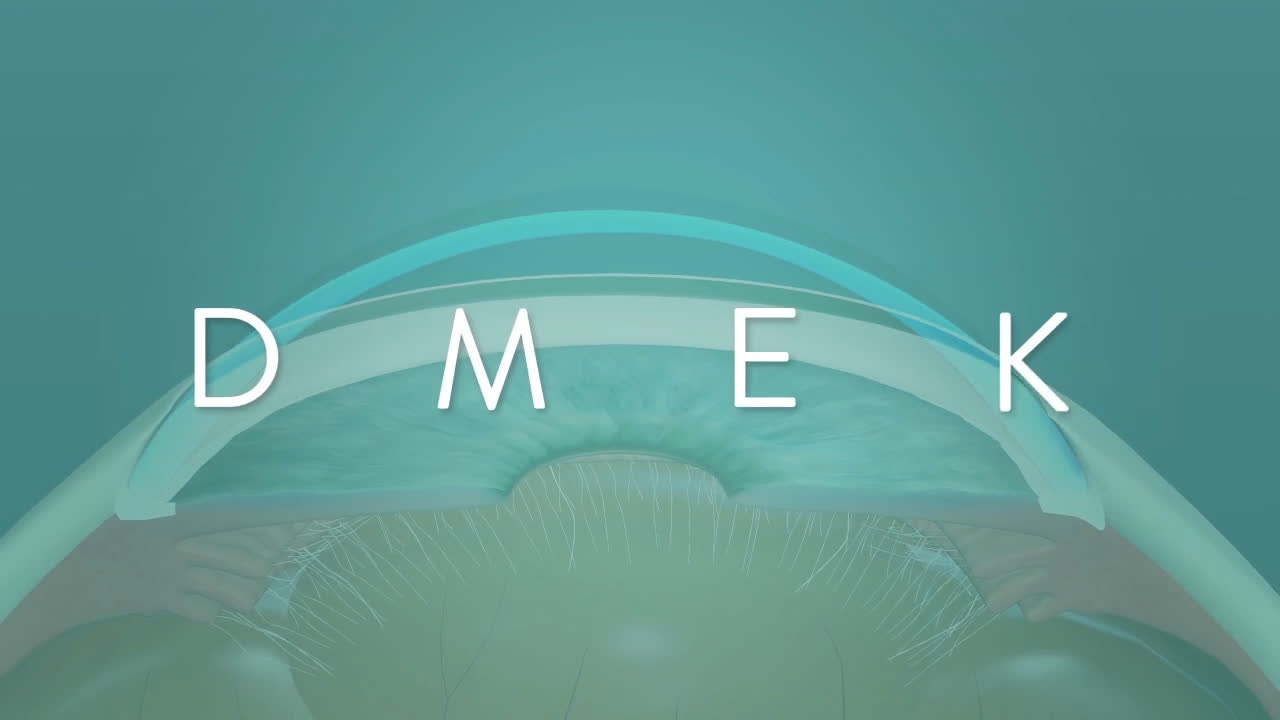
Over time, disease or injury can damage the delicate innermost layer of the eye’s cornea, called the endothelium. This damage can cause the cornea to swell and become cloudy, leading to blurred vision. A way to restore vision when the endothelium is damaged is Descemet’s Membrane Endothelial Keratoplasty, or DMEK. DMEK is a partial transplant method that uses microscopic incisions to replace just the endothelial layer of cells, instead of the entire cornea. Because the corneal surface is kept intact, the eye is stronger and less prone to injury compared to a full corneal transplant. This allows for a faster visual recovery, few activity restrictions, and minimal change in glasses prescription. During DMEK, eye drops will first be applied to numb the eye area. Your surgeon will make a small incision and remove the damaged inner cell layer of the cornea and implant the healthy donor tissue. Then, an air bubble will be used to unfold and position the donor tissue against your cornea. As the bubble is absorbed by the eye in the following days, the cells remain in their proper position. In some cases, the new transplant does not adhere to the back of the cornea and may require a second repositioning procedure. Once the transplant is firmly attached, the corneal cloudiness goes away, and good vision returns. After surgery, you should plan to be in the hospital for a few hours and arrange for someone to drive you home. Your vision should improve over the course of the following weeks, during which time you should follow your doctor’s post-operative care instructions. Talk with us if you have questions about DMEK.
Medical sources
- aao.org/eye-health/diseases/what-is-fuchs-dystrophy
- aao.org/eye-health/tips-prevention/ophthalmology-subspecialists
This page and video are for general patient education and are not a substitute for a medical examination, diagnosis, or treatment. Eye conditions vary by individual. For advice about your eyes, schedule an evaluation with May Eye Care Center. In an emergency, call 911.
Schedule your eye exam at May Eye Care Center in Hanover, PA
Serving York, Gettysburg, Adams County, and northern Maryland (driving distances). Call (717) 637-1919 or explore more about cornea at our practice.
Call (717) 637-1919