What Is Presbyopia?
Presbyopia is the gradual, age-related loss of the eye's ability to focus on near objects. The lens inside the eye, which is flexible and easily focuses up close when you are young, slowly stiffens with age until it can no longer change shape enough for reading distance. This is why small print on a menu, phone, or newspaper blurs starting in your 40s. It is a normal part of aging that eventually affects everyone.
§Read video transcript
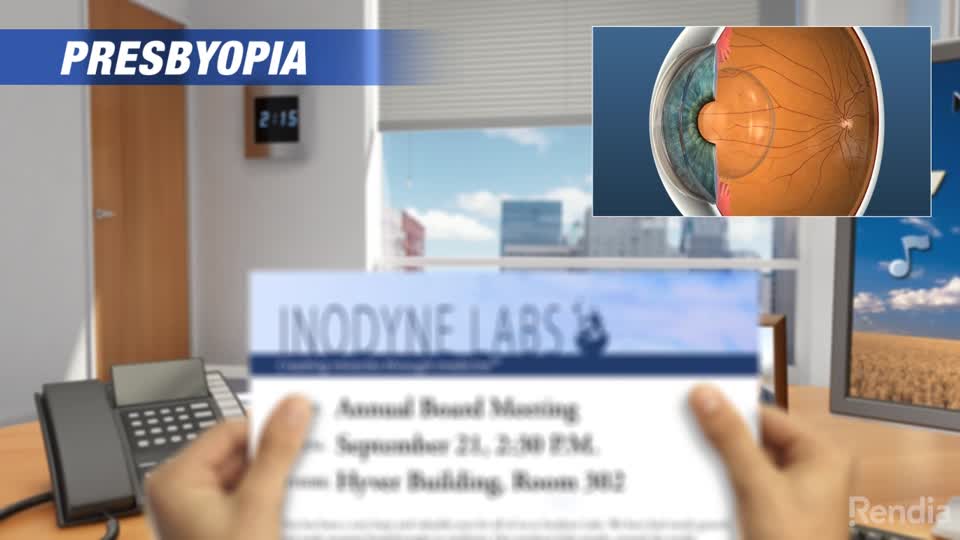
When we are young, the lens inside of our eye is extremely flexible, and allows us to easily focus on close objects. Over time, the lens gradually loses its flexibility, which makes it difficult to focus on close objects. This condition is called Presbyopia, and it is a normal part of the aging process that happens to everyone, even those who have never had a vision problem before. In the early stages of Presbyopia, most people have difficulty reading small print, such as on a menu, a cell phone, or a newspaper. People usually compensate for this, by holding reading materials further away, and in some cases by using additional light. As the condition progresses, most patients are unable to hold printed materials far enough away to see them clearly. Patients will often complain that their arms are not long enough anymore. At this stage, most patients will require some type of near vision correction. Because the lenses inside our eyes continue to change over time, it is important to see your eye care professional regularly, for routine eye examinations.
Key Takeaways
- Presbyopia is the stiffening of the lens with age, reducing your ability to focus on close objects.
- It is a normal aging change, not a disease, and it happens to everyone — even people who never had a vision problem.
- Early signs are difficulty reading small print and holding reading material farther away, often with more light.
- As it progresses, arm's length is no longer far enough and near correction becomes necessary.
- Because the lens keeps changing, regular eye exams keep your correction and eye health up to date.
Why Patients Ask This Question
Patients usually arrive because reading has quietly become harder — the phone, the medicine bottle, the crossword. Many are surprised because their distance vision is fine and they have never worn glasses. They wonder why it started so suddenly and whether it will keep getting worse. Learning that it is presbyopia, a predictable and universal aging change, is a relief rather than a diagnosis of disease.
What This Means for Your Eyes
To see something up close, the lens must bulge and add focusing power, a process called accommodation. When we are young, the lens is extremely flexible and does this effortlessly. Over time it gradually loses that flexibility, so focusing on close objects becomes difficult and small print blurs.
The effect is limited to near vision; distance vision is usually unaffected by presbyopia itself. People first compensate by holding reading materials farther away and using extra light, but eventually most cannot hold print far enough to see it clearly and need some form of near correction.
Detailed Explanation
The lens sits behind the pupil and, with the cornea, focuses light onto the retina. For near focus, the ciliary muscle relaxes tension on the lens so it becomes rounder and more powerful. Presbyopia develops because the lens steadily loses the elasticity required for that shape change, and it also continues growing and becomes denser throughout life.
In the early stages, most people notice trouble reading small print and instinctively hold the page farther away, sometimes reaching for brighter light. As the condition progresses, they can no longer hold printed material far enough away to see it clearly — the familiar complaint that "my arms aren't long enough anymore." At that point some form of near correction is needed. Presbyopia typically begins around 40 and advances into the mid-60s, so near correction usually needs periodic updating.
When This May Be Serious
Presbyopia is a normal, benign aging change and is not dangerous. However, if near blur is joined by other symptoms — distortion where straight lines look wavy, glare or halos, a drop in distance vision, worse blur in one eye, or blur that reading glasses do not fix — the cause may not be presbyopia alone. An early cataract, dry eye, or retinal problem can mimic or accompany it, so those symptoms deserve a medical eye exam.
How an Ophthalmologist Evaluates This
Diagnosis is made through a standard eye exam. The doctor measures your distance prescription and then, through near refraction, determines the reading "add" that lets you see comfortably at reading distance. The lens is examined at the slit lamp for early cataract, and a dilated exam confirms the retina and optic nerve are healthy. This straightforward evaluation both confirms presbyopia and rules out other causes of near blur.
Treatment Options
Presbyopia is corrected, not cured, and there are many good options. Over-the-counter or prescription reading glasses are the simplest. Bifocals and progressive (no-line) lenses combine distance and near correction in one pair for people who already wear glasses. Contact lens wearers can use multifocal contacts or monovision, where one eye is corrected for distance and the other for near. For those seeking to reduce dependence on glasses, presbyopia-correcting lens implants can be placed during cataract surgery, and prescription drops that temporarily sharpen near focus are available for some patients. The right choice depends on your daily activities and preferences.
What You Should Not Do
- Do not assume something is wrong with your eyes; presbyopia is a normal aging change.
- Do not simply grab the strongest readers available — the correct near power depends on your eyes and reading distance.
- Do not avoid reading glasses out of fear they will weaken your eyes; they will not, and presbyopia advances regardless.
- Do not ignore near blur that comes with glare, distortion, or a drop in distance vision, since that points to another cause.
When to Call May Eye Care Center
Reach out if reading has become a strain, if store-bought readers no longer work well, or if it has been over a year since your last eye-health exam. For patients in and around Hanover, a routine visit provides the right near correction and confirms the eyes are otherwise healthy. If near blur appears suddenly along with distortion, glare, or loss of distance vision, seek prompt evaluation rather than waiting.
Bottom Line
Presbyopia is the normal age-related stiffening of the lens that makes close-up focus harder starting in your 40s; it affects everyone and is easily corrected, and regular exams keep your correction and eye health on track.
This page also answers
- Why is my vision blurry even with glasses?
- Can an eye disease make my prescription change?
- What is the difference between astigmatism and presbyopia?
- Do I need glasses, surgery, or a medical eye exam?
- When should adults update their glasses prescription?
- When should this be checked urgently?
- What testing helps confirm the diagnosis?
- What treatments are available?
- What should patients avoid doing at home?
Medical sources
- nei.nih.gov/eye-health-information/eye-conditions-and-diseases/refractive-errors
- nei.nih.gov/eye-health-information/eye-conditions-and-diseases/astigmatism
- aao.org/eye-health/tips-prevention/eye-exams-101
This article is for educational purposes only and is not a diagnosis, treatment plan, or substitute for an eye examination by a qualified eye doctor. Eye symptoms can have many causes, and some problems can threaten vision if they are not treated promptly. Do not diagnose or treat yourself based only on online information. If you have eye pain, sudden vision loss, flashes, new floaters, a curtain or shadow in your vision, double vision, chemical exposure, trauma, severe redness, light sensitivity, or any concerning eye symptom, seek urgent medical eye care or emergency care.
Schedule your eye exam at May Eye Care Center in Hanover, PA
Serving York, Gettysburg, Adams County, and northern Maryland (driving distances). Call (717) 637-1919 or explore more about eye exam & vision at our practice.
Call (717) 637-1919