Why Do I Need Reading Glasses After Age 40?
Reading glasses become necessary around 40 because of presbyopia — the natural stiffening of the lens inside your eye. When you are young, that lens flexes easily to focus on close objects; with age it gradually hardens and can no longer change shape enough for near work, so small print blurs and you hold things farther away. It happens to everyone, even people who never needed glasses, and it is not a disease.
Key Takeaways
- Presbyopia is the age-related loss of the lens's ability to focus up close, becoming noticeable in the early-to-mid 40s.
- It affects nearly everyone eventually, including people who had perfect vision their whole life.
- The classic sign is holding menus, phones, or newspapers farther away and wanting more light to read.
- It is a normal aging change, not an illness, and it does not mean your eyes are diseased.
- Red flag: if reading blur comes with distortion, glare, or a drop in distance vision, that is not simple presbyopia and should be examined.
Why Patients Ask This Question
People are often caught off guard when, seemingly overnight in their 40s, they can no longer read a text message or a restaurant menu that was fine last year. Many have never worn glasses and feel their eyes are suddenly "going." The common joke is that their arms are not long enough anymore. Understanding that this is a predictable, universal change — not a sign of damage — takes away most of the worry.
What This Means for Your Eyes
Focusing on something close requires the lens to bulge and add power, a process called accommodation, controlled by a ring of muscle around the lens. In youth the lens is soft and springy, so this is effortless. Over decades the lens proteins stiffen and it grows less pliable, so even with the muscle working, it cannot add enough power for near tasks.
The result is blur at reading distance while distance vision usually stays the same. Reading glasses, or the near portion of bifocals and progressives, simply supply the extra focusing power the lens can no longer produce on its own.
Detailed Explanation
The lens sits just behind the pupil and works with the cornea to focus light on the retina. To focus up close, the ciliary muscle relaxes tension on the lens so it becomes rounder and more powerful. Presbyopia occurs because the lens gradually loses the elasticity needed for this shape change, and it also continues to grow denser throughout life.
Early on, people compensate by holding reading material at arm's length and adding brighter light, which shrinks the pupil and sharpens near focus. As the lens stiffens further, arm's length is no longer far enough and near correction becomes necessary. The process typically begins around 40 to 45 and continues until the mid-60s. Nearsighted people can sometimes still read by removing their distance glasses, while farsighted people often feel presbyopia earlier and more strongly.
When This May Be Serious
Presbyopia itself is entirely benign. Be evaluated, though, if near blur comes with warning signs that point elsewhere: new distortion where lines look wavy, glare or halos around lights, a decline in distance vision, blur that is worse in one eye, or blur that does not improve with reading glasses. Those suggest another cause such as an early cataract, dry eye, or a retinal issue, and deserve a medical eye exam.
How an Ophthalmologist Evaluates This
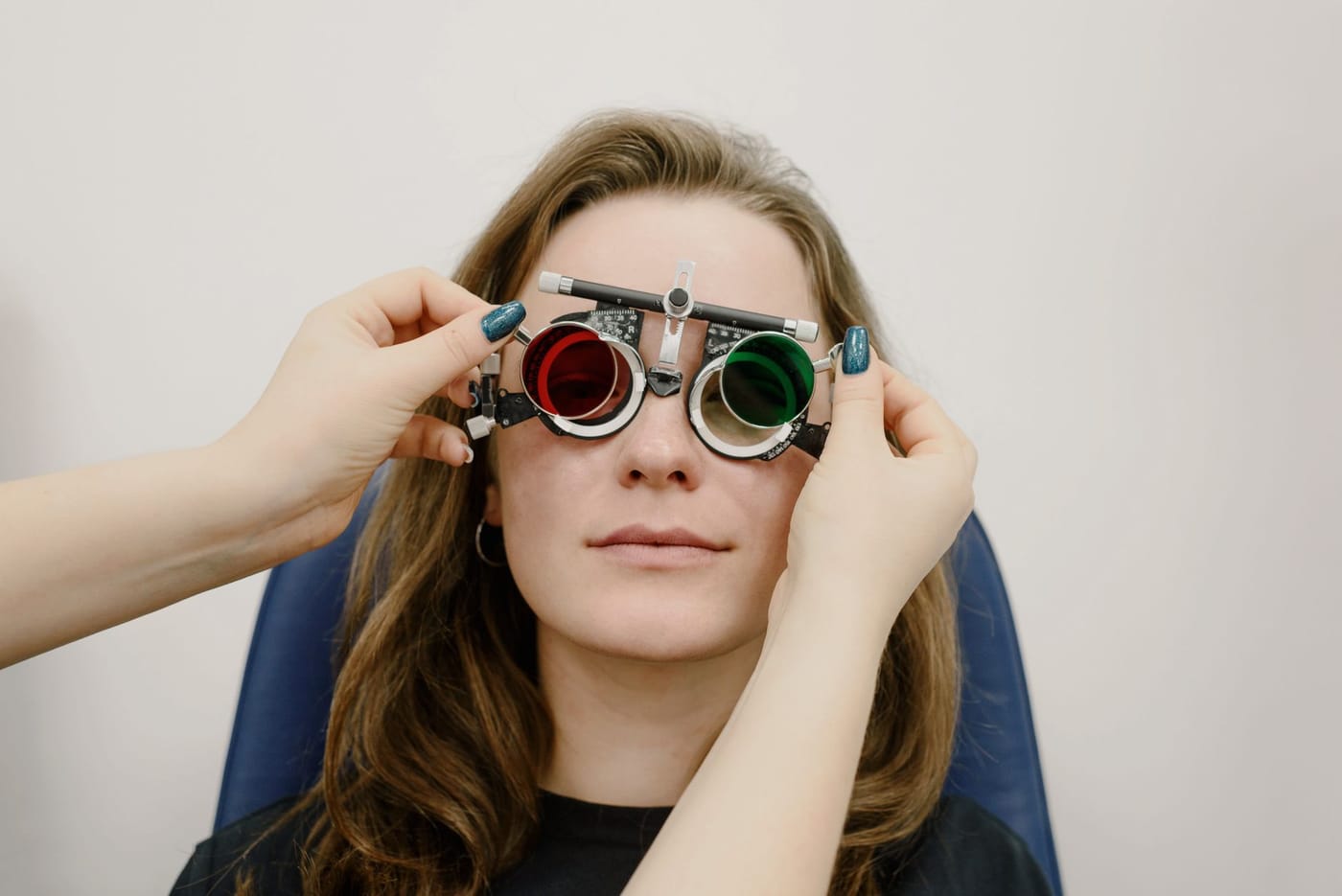
The diagnosis is straightforward. The doctor measures your distance prescription and then determines the near "add" — the extra power that lets you read comfortably — through refraction at reading distance. During the same visit, the lens is checked at the slit lamp to be sure an early cataract is not contributing, and a dilated exam confirms the retina and optic nerve are healthy. This distinguishes plain presbyopia from other reasons near vision might blur.
Treatment Options
The simplest option is reading glasses, either over-the-counter for mild cases or prescription lenses when your eyes differ or you have astigmatism. Progressive lenses give a seamless range from distance to near in one pair, and bifocals do the same with a visible line. Contact lens wearers can use multifocal contacts or monovision, where one eye is set for distance and the other for near. Surgical options exist too, including presbyopia-correcting lens implants at cataract surgery, and prescription eye drops that temporarily improve near focus for some people. The best choice depends on your prescription and lifestyle.
What You Should Not Do
- Do not assume you need the strongest drugstore readers; the right power for your eyes and reading distance matters.
- Do not skip an eye exam if reading blur is one-sided or comes with distortion or glare.
- Do not worry that using reading glasses will "make your eyes lazy" — it will not; presbyopia progresses on its own regardless.
- Do not strain to read in dim light when a simple correction solves the problem.
When to Call May Eye Care Center
Schedule a visit if near tasks have become a struggle, if drugstore readers are not cutting it, or if it has been a year or more since your last eye-health exam. For patients in the Hanover area, a routine exam both sets you up with the right reading correction and confirms the rest of your eyes are healthy. Seek prompt care instead if reading blur arrives suddenly with distortion, glare, or loss of distance vision.
Bottom Line
Needing reading glasses after 40 is presbyopia, the normal age-related stiffening of the lens, and it happens to nearly everyone; a simple exam gets you the right correction and confirms your eyes are otherwise healthy.
This page also answers
- Why is my vision blurry even with glasses?
- Can an eye disease make my prescription change?
- What is the difference between astigmatism and presbyopia?
- Do I need glasses, surgery, or a medical eye exam?
- When should adults update their glasses prescription?
- When should this be checked urgently?
- What testing helps confirm the diagnosis?
- What treatments are available?
- What should patients avoid doing at home?
Medical sources
- nei.nih.gov/eye-health-information/eye-conditions-and-diseases/refractive-errors
- nei.nih.gov/eye-health-information/eye-conditions-and-diseases/astigmatism
- aao.org/eye-health/tips-prevention/eye-exams-101
This article is for educational purposes only and is not a diagnosis, treatment plan, or substitute for an eye examination by a qualified eye doctor. Eye symptoms can have many causes, and some problems can threaten vision if they are not treated promptly. Do not diagnose or treat yourself based only on online information. If you have eye pain, sudden vision loss, flashes, new floaters, a curtain or shadow in your vision, double vision, chemical exposure, trauma, severe redness, light sensitivity, or any concerning eye symptom, seek urgent medical eye care or emergency care.
Schedule your eye exam at May Eye Care Center in Hanover, PA
Serving York, Gettysburg, Adams County, and northern Maryland (driving distances). Call (717) 637-1919 or explore more about eye exam & vision at our practice.
Call (717) 637-1919