
Can Ozempic, Wegovy, Mounjaro or Zepbound Affect Your Eyes?
What the evidence actually shows about semaglutide (Ozempic, Wegovy, Rybelsus) and tirzepatide (Mounjaro, Zepbound): diabetic retinopathy, the rare optic-nerve condition NAION, sudden vision loss, and what to tell your surgical team.
Most people taking GLP-1–based medications do not develop a serious eye complication. The two eye issues that matter most are temporary worsening of pre-existing diabetic retinopathy when blood sugar improves rapidly, and a rare optic-nerve condition called NAION that has been associated most consistently with semaglutide. Sudden painless loss or dimming of vision in one eye requires urgent evaluation. Do not stop a medication solely because of an online headline; discuss your individual risks with the prescribing clinician and your eye doctor.
Key facts
- Does semaglutide cause diabetic retinopathy?
- Semaglutide is associated with early worsening of diabetic retinopathy, mainly in patients who already have retinopathy and whose blood sugar improves rapidly. A 2025 meta-analysis of 78 randomized trials (73,640 participants) found no significant overall increase in diabetic retinopathy, or in eye disorders generally.
- Does semaglutide cause NAION?
- Semaglutide has a credible but rare NAION safety signal. The European Medicines Agency classifies NAION as a very rare side effect; large observational studies suggest about a two-fold relative increase, but the absolute risk is low and observational data cannot prove causation.
- What number best communicates the absolute NAION risk?
- The EMA estimate: approximately one additional case of NAION per 10,000 person-years of semaglutide treatment.
- Does every GLP-1 patient need a special eye exam?
- The 2026 AAO/NANOS statement calls for individualized shared decision-making rather than a blanket screening rule. People with diabetes should keep their recommended diabetic eye examinations — the drug labels advise monitoring anyone with a history of diabetic retinopathy — and people with prior NAION or known optic-nerve or retinal disease should discuss follow-up with their eye doctor before starting.
- What is the emergency symptom?
- Sudden painless loss of vision in one eye, or a new missing area of the visual field. It needs prompt ophthalmic evaluation.
- Should patients stop the medication on their own?
- No. Medication changes should be coordinated with the prescriber and the eye doctor. If NAION is confirmed, current European semaglutide labeling advises stopping the medication.
What are GLP-1–based medications?
Semaglutide is the active medication in Ozempic®, Wegovy® and Rybelsus®. Tirzepatide is the active medication in Mounjaro® and Zepbound® and acts on both GIP and GLP-1 receptors. These medicines can produce major benefits for diabetes, obesity and cardiovascular risk in appropriately selected patients. Their eye risks should be put in context rather than described with blanket phrases such as “Ozempic blindness.”
Can semaglutide worsen diabetic retinopathy?
It can be associated with a temporary worsening of diabetic retinopathy, particularly when a person already has diabetic retinopathy and blood glucose improves quickly. This “early worsening” phenomenon has been recognized with intensive diabetes treatment for decades, and it is not the same as proving that semaglutide is directly toxic to the retina.
| Evidence | The number patients should understand |
|---|---|
| SUSTAIN-6 randomized trial (2016) | Diabetic-retinopathy complications in 3.0% of patients on semaglutide versus 1.8% on placebo. |
| Patients who already had diabetic retinopathy | 8.2% with semaglutide versus 5.2% with placebo (current U.S. Ozempic prescribing information). |
| Patients without known diabetic retinopathy | 0.7% versus 0.4%. |
| Broader randomized evidence (2025 meta-analysis) | 78 trials and 73,640 participants: no significant overall increase in diabetic retinopathy — odds ratio 1.04 (95% CI 0.92–1.17). |
What is NAION, and what does semaglutide have to do with it?
Non-arteritic anterior ischemic optic neuropathy (NAION) is an uncommon condition in which part of the optic nerve is injured after insufficient blood supply. It usually produces sudden, painless vision loss in one eye. Patients may notice a dark or gray area, dim vision, or a missing upper or lower portion of the visual field. Our neuro-ophthalmology pages cover optic-nerve conditions in more detail.
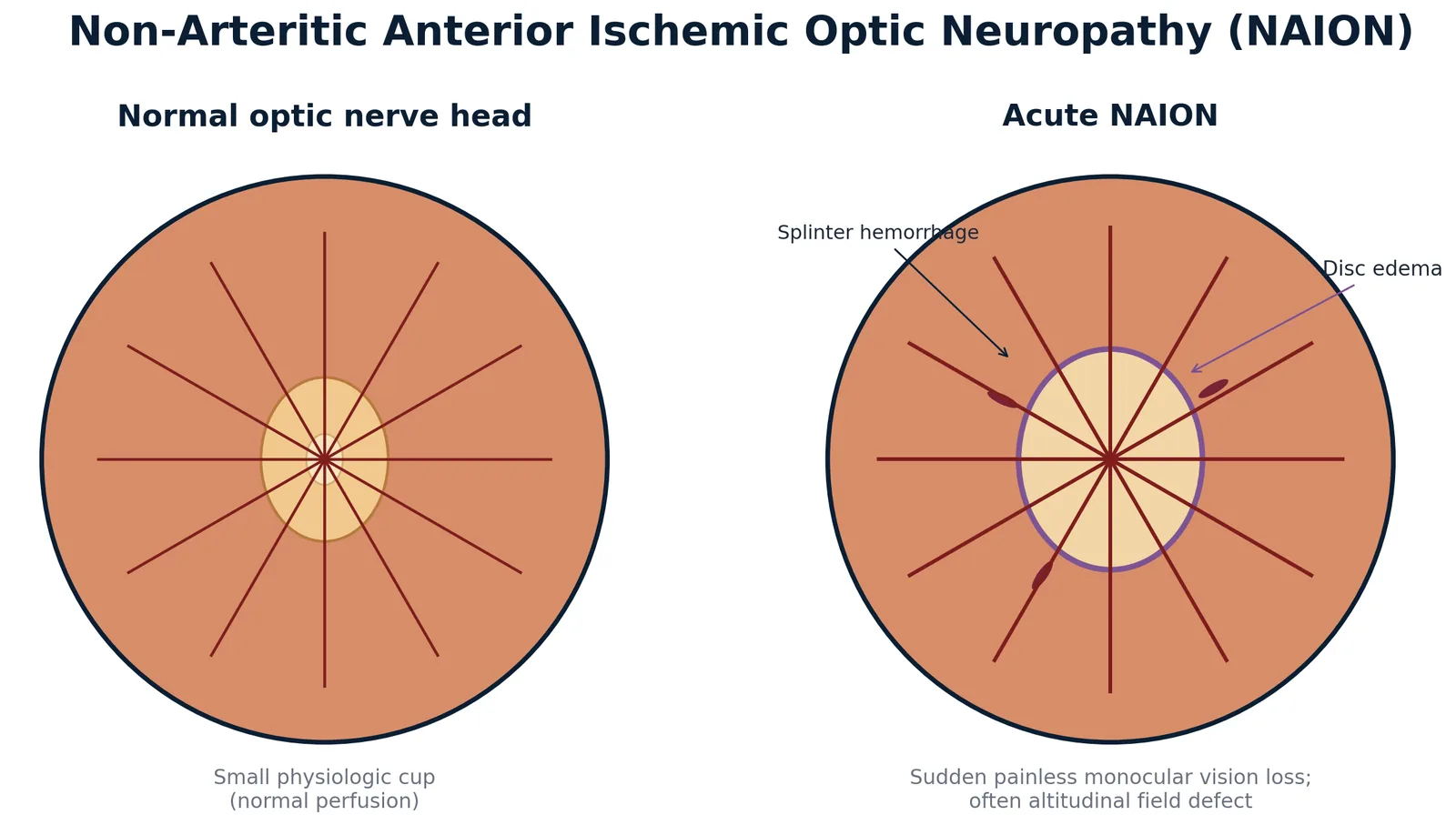
Several large observational studies have reported more NAION among semaglutide users. A Danish nationwide study of 424,152 people with type 2 diabetes found a hazard ratio of 2.19. A Danish–Norwegian study found a pooled hazard ratio of 2.81 and an absolute excess of about 1.41 cases per 10,000 person-years. These studies cannot completely eliminate confounding, because diabetes, sleep apnea and vascular disease themselves increase NAION risk.
The 2026 joint consensus statement from the North American Neuro-Ophthalmology Society and the American Academy of Ophthalmology treats the signal seriously but emphasizes that the overall magnitude of the risk remains low and that the evidence comes from retrospective observational studies with real limitations. It calls for shared decision-making between each patient and their care team about whether to start, continue or stop a GLP-1 medication, weighing the medication’s systemic benefits against the individual’s ocular risk.
The evidence is also not uniform. A 2026 systematic review of six observational studies found that, after adjustment, the pooled estimates did not show a consistent overall increase in NAION, with low to very low certainty — a reminder that the question is still being studied, and that an association is not the same as proof of cause.
Is this a proven “GLP-1 class effect”?
No. The strongest current NAION evidence is for semaglutide. Tirzepatide has appeared in observational datasets and case reports, but it should not be presented as having the same proven risk, and the evidence for it is thinner in either direction. Tirzepatide’s U.S. labeling does warn that rapid improvement in glucose control can temporarily worsen diabetic retinopathy in susceptible patients. The evidence should be stated drug by drug whenever possible.
Who should be especially careful?
- People with significant pre-existing diabetic retinopathy, especially when very high blood sugar is expected to improve rapidly.
- People who have already had NAION in one eye.
- People with common NAION risk factors such as diabetes, obstructive sleep apnea, hypertension or other vascular risk factors, nocturnal hypotension, or a small, “crowded” optic nerve.
- Anyone who develops a new, unexplained visual-field defect, sudden dimming, or painless loss of vision.
Can these drugs cause temporary blurry vision?
Yes, sometimes indirectly. Large and rapid changes in blood glucose can temporarily change the focusing power of the natural lens inside the eye. That can cause a short-term refractive shift and blurry vision. Persistent blur should not simply be blamed on the medication, because diabetic macular edema, cataract, retinal vascular disease, optic neuropathy and other eye conditions can also reduce vision.
When is a vision change an emergency?
Should I stop Ozempic, Wegovy, Mounjaro or Zepbound?
Do not stop an otherwise beneficial medication simply because you read that it can affect the eyes. If NAION is suspected or confirmed, the ophthalmologist and the prescribing clinician should communicate promptly. European semaglutide product information advises stopping semaglutide when NAION is confirmed. U.S. labeling and specialty-society guidance should be checked at the time of treatment, because regulatory language can change.
GLP-1 medications and eye surgery or sedation
Semaglutide and tirzepatide delay stomach emptying. Current U.S. labels report rare cases of pulmonary aspiration during general anesthesia or deep sedation in patients who had residual stomach contents despite reporting that they had followed fasting instructions. If you take one of these medicines, tell the surgical and anesthesia team before any procedure, including cataract surgery. Do not stop the medication on your own; follow the individualized instructions from the team managing your procedure.
Diabetes with known retinopathy
Make sure your retinal follow-up is current, and watch more closely while blood sugar is falling quickly.
Sudden painless vision loss
An urgent eye examination the same day, for NAION, retinal vascular disease or another acute cause.
Planned anesthesia or sedation
Tell the surgical and anesthesia team what you take and when you last took it; they weigh the aspiration risk and give you instructions.
Do not stop a medication because of an eye-risk headline. The absolute NAION risk is low, and the retinopathy risk is concentrated in people who already have retinopathy and whose glucose is improving rapidly. The decision belongs to you, your prescriber and your eye doctor together.
The bottom line
GLP-1–based medications offer substantial health benefits, and serious eye complications remain uncommon. Ophthalmology focuses on two practical issues: watch patients with pre-existing diabetic retinopathy when blood sugar changes rapidly, and take sudden painless vision loss seriously because of the emerging semaglutide–NAION association. Accurate risk communication means discussing both relative risk and absolute risk.
Frequently asked questions
01Does Ozempic cause blindness?
Blindness is not a common or expected effect of Ozempic. Semaglutide has been associated with the rare optic-nerve condition NAION, and rapid glucose improvement can temporarily worsen pre-existing diabetic retinopathy. Sudden vision loss needs urgent evaluation.
02How common is NAION with semaglutide?
NAION is uncommon. The European Medicines Agency’s 2025 review estimated approximately one additional case per 10,000 person-years of semaglutide treatment, based on epidemiologic data; estimates vary by population and study design.
03Does Mounjaro have the same NAION risk as Ozempic?
That has not been established. The strongest current NAION signal is for semaglutide. The tirzepatide evidence is less definitive and should not automatically be treated as identical.
04Why can diabetic retinopathy worsen after starting a powerful diabetes medicine?
A rapid improvement in blood glucose can temporarily worsen existing retinopathy — an effect known from intensive diabetes treatment well before GLP-1 drugs. The risk is highest in people who already have retinopathy and undergo a large, rapid HbA1c reduction.
05Do I need an eye exam before starting Ozempic or Wegovy?
The 2026 AAO/NANOS statement calls for individualized shared decision-making rather than a blanket rule, and the drug labels advise monitoring anyone with a history of diabetic retinopathy. If you have diabetes, stay current with your recommended diabetic eye examinations; if you have known retinal or optic-nerve disease, or have had NAION before, discuss a baseline examination and follow-up with your eye doctor before starting.
06What vision symptoms should I never ignore?
Sudden painless vision loss, a new dark or gray area, a missing portion of the visual field, or rapidly worsening vision should be assessed promptly.
07Can changing blood sugar make my glasses prescription change?
Yes. Rapid glucose changes can temporarily alter the lens and shift refraction. A new glasses prescription may not remain accurate until glucose is more stable.
08Should I stop a GLP-1 drug before cataract surgery?
Do not make that decision yourself. These drugs can delay gastric emptying, which matters for anesthesia and deep sedation. Tell the surgical team exactly what you take and follow their current individualized protocol.
The May Eye Care Center & Associates is in Hanover, Pennsylvania, in York County, and sees patients from York County, PA, Adams County, PA, and Carroll County, MD and the surrounding region. If you have diabetes and take one of these medications, your yearly dilated diabetic eye examination is the right place to talk through retinopathy follow-up, and we coordinate with the clinician who prescribes your medication. Call (717) 637-1919 to schedule, or see the driving distances from towns across the region.
Sources
Primary trials, systematic reviews and meta-analyses, consensus statements, regulators, and current U.S. prescribing information are prioritized. Product labels change; each label was read on DailyMed on October 4, 2026.
- Marso SP, Bain SC, Consoli A, et al.; SUSTAIN-6 Investigators. Semaglutide and cardiovascular outcomes in patients with type 2 diabetes. N Engl J Med. 2016;375(19):1834-1844. doi:10.1056/NEJMoa1607141. PMID 27633186. pubmed.ncbi.nlm.nih.gov/27633186 (opens in a new tab)
- Vilsbøll T, Bain SC, Leiter LA, et al. Semaglutide, reduction in glycated haemoglobin and the risk of diabetic retinopathy. Diabetes Obes Metab. 2018;20(4):889-897. doi:10.1111/dom.13172. PMID 29178519. pubmed.ncbi.nlm.nih.gov/29178519 (opens in a new tab)
- Natividade GR, Spiazzi BF, Baumgarten MW, et al. Ocular adverse events with semaglutide: a systematic review and meta-analysis. JAMA Ophthalmol. 2025;143(9):759-768. doi:10.1001/jamaophthalmol.2025.2489. PMID 40810985. pubmed.ncbi.nlm.nih.gov/40810985 (opens in a new tab)
- Grauslund J, Taha AA, Molander LD, et al. Once-weekly semaglutide doubles the five-year risk of nonarteritic anterior ischemic optic neuropathy in a Danish cohort of 424,152 persons with type 2 diabetes. Int J Retina Vitreous. 2024;10(1):97. doi:10.1186/s40942-024-00620-x. PMID 39696569. pubmed.ncbi.nlm.nih.gov/39696569 (opens in a new tab)
- Simonsen E, Lund LC, Ernst MT, et al. Use of semaglutide and risk of non-arteritic anterior ischaemic optic neuropathy: a Danish-Norwegian cohort study. Diabetes Obes Metab. 2025;27(6):3094-3103. doi:10.1111/dom.16316. PMID 40098249. pubmed.ncbi.nlm.nih.gov/40098249 (opens in a new tab)
- Abdelaal A, Abu Serhan H, Alsaadi M, et al. Semaglutide and the risk of nonarteritic ischemic optic neuropathy: a systematic review and certainty of evidence meta-analysis. Ophthalmology. 2026;133(6):799-810. doi:10.1016/j.ophtha.2026.02.013. PMID 41692115. pubmed.ncbi.nlm.nih.gov/41692115 (opens in a new tab)
- DeParis SW, Oke I, Gaier ED, et al. Glucagon-like peptide-1 receptor agonists and the risk of non-arteritic anterior ischemic optic neuropathy: a consensus statement by the North American Neuro-Ophthalmology Society and the American Academy of Ophthalmology. Ophthalmology. 2026;133(8):1029-1035. doi:10.1016/j.ophtha.2026.04.008. PMID 42132708. pubmed.ncbi.nlm.nih.gov/42132708 (opens in a new tab)
- Katz BJ, Lee MS, Lincoff NS, et al. Ophthalmic complications associated with the antidiabetic drugs semaglutide and tirzepatide. JAMA Ophthalmol. 2025;143(3):215-220. doi:10.1001/jamaophthalmol.2024.6058. PMID 39883468. pubmed.ncbi.nlm.nih.gov/39883468 (opens in a new tab)
- European Medicines Agency, Pharmacovigilance Risk Assessment Committee. PRAC concludes eye condition NAION is a very rare side effect of semaglutide medicines Ozempic, Rybelsus and Wegovy. 6 June 2025. ema.europa.eu/en/news/prac-concludes-eye-condition-naion-very-rare-side-effect-semaglutide-medicines-ozempic-rybelsus-wegovy (opens in a new tab)
- Ozempic (semaglutide) injection. Current U.S. prescribing information, Warnings and Precautions 5.3 (Diabetic Retinopathy Complications) and 5.10 (Pulmonary Aspiration During General Anesthesia or Deep Sedation). DailyMed, U.S. National Library of Medicine. dailymed.nlm.nih.gov/dailymed/drugInfo.cfm?setid=adec4fd2-6858-4c99-91d4-531f5f2a2d79 (opens in a new tab)
- Wegovy (semaglutide). Current U.S. prescribing information, Warnings and Precautions 5.8 (Diabetic Retinopathy Complications in Patients with Type 2 Diabetes) and 5.10 (Pulmonary Aspiration). DailyMed. dailymed.nlm.nih.gov/dailymed/drugInfo.cfm?setid=ee06186f-2aa3-4990-a760-757579d8f77b (opens in a new tab)
- Mounjaro (tirzepatide) injection. Current U.S. prescribing information, Warnings and Precautions 5.7 (Diabetic Retinopathy Complications) and 5.9 (Pulmonary Aspiration). DailyMed. dailymed.nlm.nih.gov/dailymed/drugInfo.cfm?setid=d2d7da5d-ad07-4228-955f-cf7e355c8cc0 (opens in a new tab)
- Zepbound (tirzepatide) injection. Current U.S. prescribing information, Warnings and Precautions 5.8 (Diabetic Retinopathy Complications in Patients with Type 2 Diabetes Mellitus) and 5.9 (Pulmonary Aspiration). DailyMed. dailymed.nlm.nih.gov/dailymed/drugInfo.cfm?setid=487cd7e7-434c-4925-99fa-aa80b1cc776b (opens in a new tab)
- Kindel TL, Wang AY, Wadhwa A, et al. Multi-society clinical practice guidance for the safe use of glucagon-like peptide-1 receptor agonists in the perioperative period. Surg Endosc. 2025;39(1):180-183. doi:10.1007/s00464-024-11263-2. PMID 39370500. pubmed.ncbi.nlm.nih.gov/39370500 (opens in a new tab)
This page is general patient education published by The May Eye Care Center & Associates and is not a substitute for a medical examination, diagnosis, or treatment. Medication decisions belong with you and the clinicians who prescribe and monitor your care. In an emergency, call 911.
Ready to see
the world clearly?
Questions about a medication and your eyes? Bring your medication list to your next visit, or call to schedule an evaluation with our physicians. We coordinate with the clinician who prescribes your medication.
Contact the practice
Hanover, PA 17331