Can Cialis or Viagra Affect Your Eyes? What the Evidence Really Shows
Tadalafil (Cialis) and sildenafil (Viagra) can affect vision, but the risks are very different in size and kind: a dose-related, short-lived color tinge with sildenafil; a rare but serious NAION warning; and two 2026 glaucoma studies that point in opposite directions.
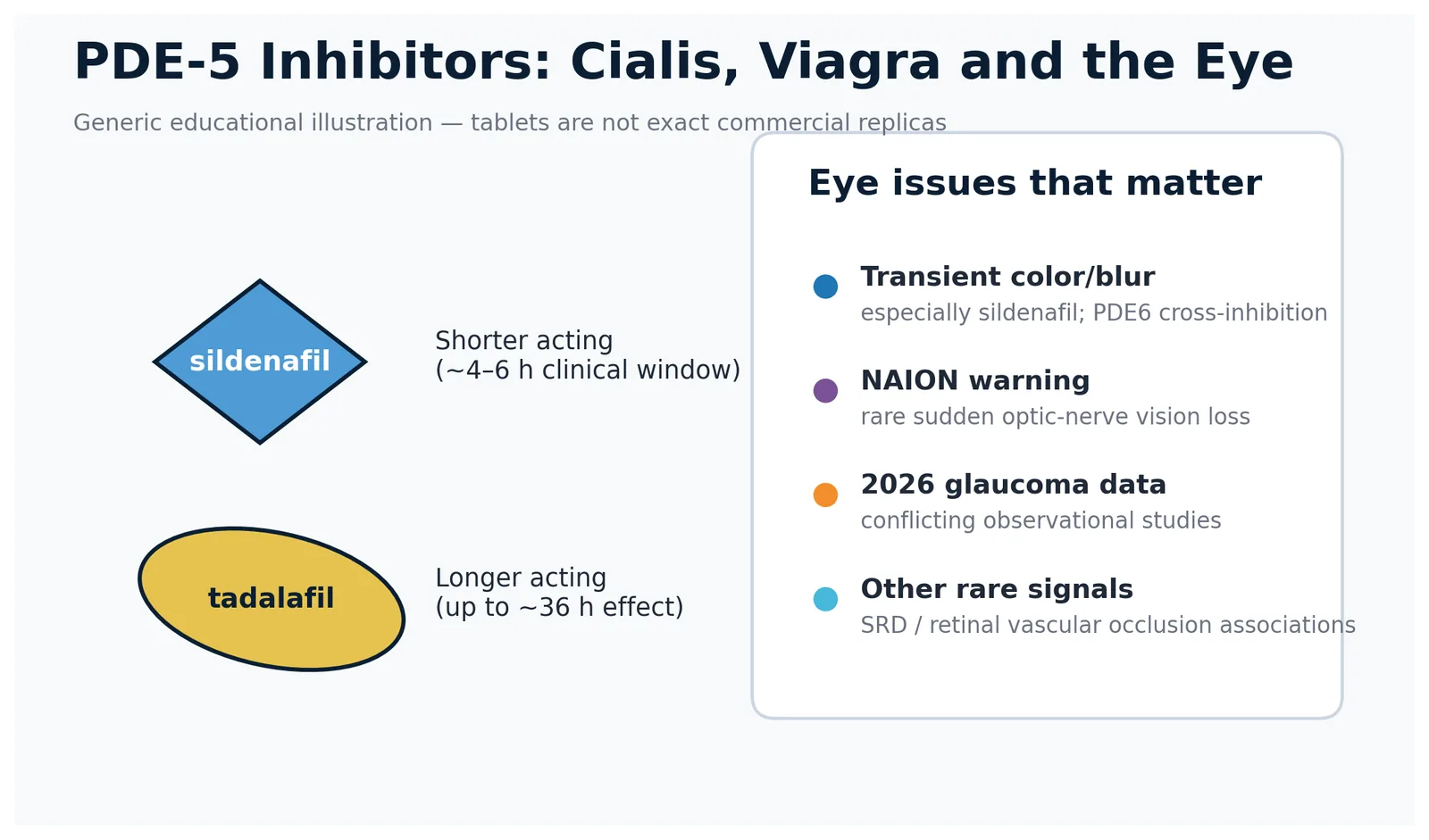
Yes, PDE-5 inhibitors such as tadalafil (Cialis) and sildenafil (Viagra) can affect vision, but the risks are very different. Sildenafil commonly causes a short-lived color tinge or blur at higher doses. Sudden vision loss is rare but can represent NAION and requires urgent evaluation. A 2026 tadalafil study reported a modest increase in glaucoma diagnoses, but another 2026 PDE-5 study found the opposite. At present, tadalafil has not been proven to cause glaucoma.
Key facts
- Does tadalafil cause glaucoma?
- Not proven. One 2026 cohort of men treated for urinary symptoms found a hazard ratio of 1.22 and a five-year incidence of 3.93% versus 3.16%; another 2026 cohort of men with erectile dysfunction found a lower hazard of open-angle glaucoma with chronic PDE-5 inhibitor use.
- What is the clearest known sildenafil eye effect?
- Transient, dose-related abnormal vision — most often a color tinge or a change in blue-green discrimination, sometimes light sensitivity or blur — consistent with partial inhibition of retinal PDE-6.
- What is the emergency warning?
- Sudden vision loss can represent NAION or another acute eye disorder. U.S. labeling directs patients to stop the PDE-5 inhibitor and seek medical attention.
- Does a NAION report prove the drug caused it?
- No. NAION and PDE-5 use share vascular risk factors; the observational studies and the product labels themselves acknowledge the uncertainty.
- What did the 2022 JAMA Ophthalmology study show?
- Associations with serous retinal detachment and ischemic optic neuropathy in insurance-claims data; the retinal vascular occlusion estimate’s confidence interval crossed 1.0. A claims study cannot establish causality.
What are Cialis and Viagra?
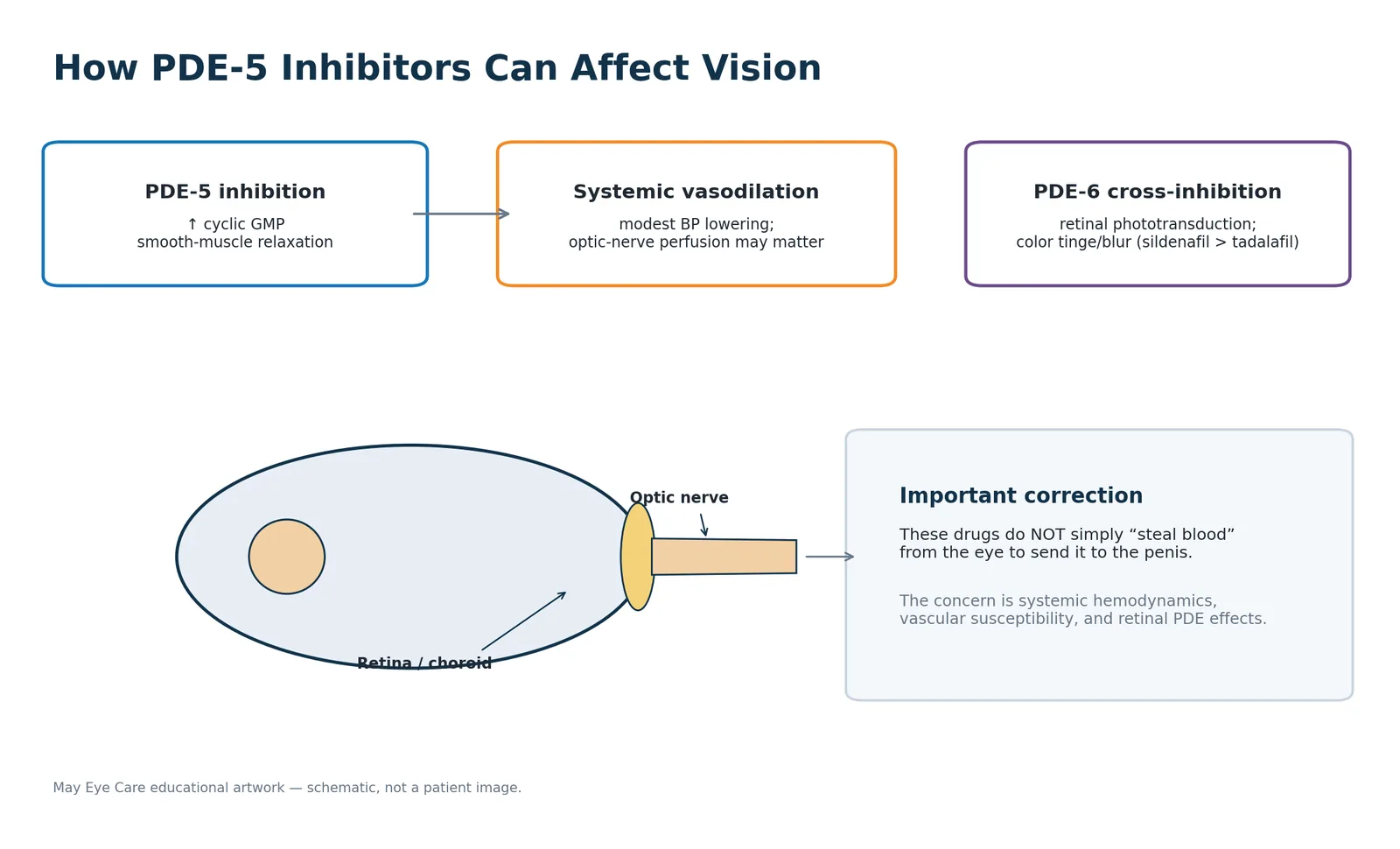
Cialis® (tadalafil) and Viagra® (sildenafil) are phosphodiesterase type-5 (PDE-5) inhibitors. They are best known for erectile dysfunction; tadalafil is also used for the urinary symptoms of benign prostatic hyperplasia, and PDE-5 drugs are used in other formulations for pulmonary hypertension. They increase nitric oxide–cGMP signaling and relax smooth muscle. Their eye effects come from systemic blood-flow changes, the eye’s own vascular physiology and — particularly for sildenafil — partial inhibition of retinal PDE-6.
Why can Viagra make vision look blue?
Sildenafil can inhibit PDE-6, an enzyme involved in the retina’s light-sensing chemistry (phototransduction). This can temporarily change blue-green color discrimination, increase sensitivity to light, or blur vision. In fixed-dose Viagra trials, “abnormal vision” was reported by about 1% of patients at 25 mg, 2% at 50 mg and 11% at 100 mg, compared with 1% on placebo. The effects were generally mild and transient.
Tadalafil is more selective. Current tadalafil labeling reports changes in color vision in fewer than 0.1% of patients across its clinical studies. A new fixed dark area, a missing part of the visual field, or marked dimming in one eye should never be dismissed as a benign color effect.
Can Cialis or Viagra cause NAION?
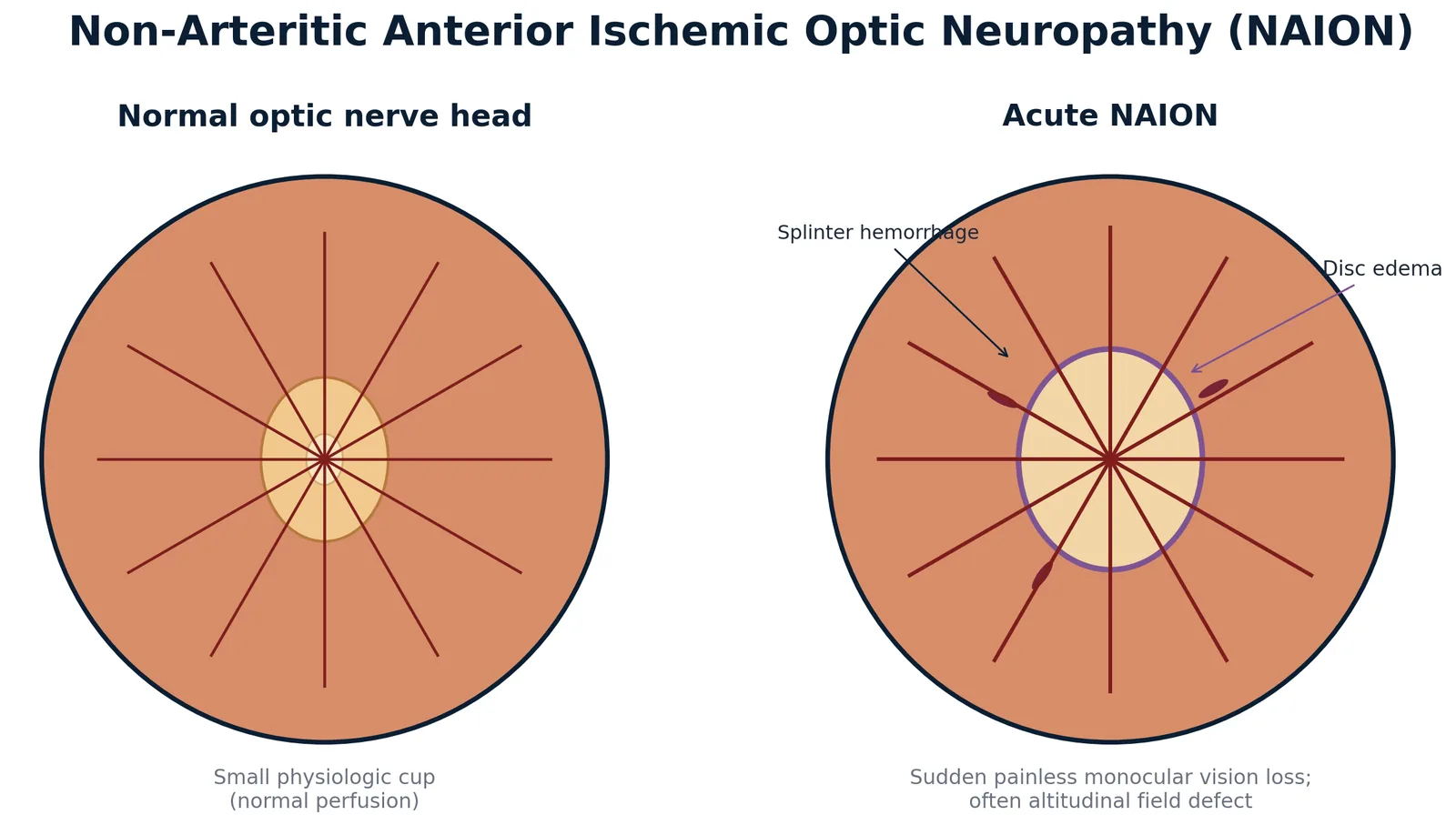
Non-arteritic anterior ischemic optic neuropathy (NAION) is an uncommon condition in which part of the optic nerve is injured after insufficient blood supply. It usually causes sudden, painless vision loss in one eye. U.S. prescribing information for both tadalafil and sildenafil carries a warning about rare postmarketing reports of NAION, and both labels instruct patients to stop the PDE-5 inhibitor and seek medical attention if sudden vision loss occurs. Our neuro-ophthalmology pages cover optic-nerve conditions in more detail.
- Patients who have already had NAION in one eye are at increased risk in the other eye; the labels say PDE-5 inhibitors should be used with caution in these patients, and only when the anticipated benefits outweigh the risks.
- A small or “crowded” optic disc is an anatomic NAION risk factor, but current labeling states that the evidence is insufficient to support screening every prospective user for it.
- Sudden painless loss of vision is an emergency symptom regardless of whether the medication ultimately caused it.
Does Cialis increase glaucoma risk? The new 2026 study
A multinational cohort study published in 2026 compared men aged 40 and older who took tadalafil for lower urinary tract symptoms with matched men who took no PDE-5 inhibitor. It reported a modest association with new glaucoma diagnoses. The numbers deserve to be read carefully.
| Measure | Result |
|---|---|
| Matched participants | 36,927 tadalafil users versus 36,927 men taking no PDE-5 inhibitor. |
| Any glaucoma | Hazard ratio 1.22 (95% CI 1.12–1.33). |
| Five-year cumulative incidence | 3.93% versus 3.16% — an absolute difference of 0.77 percentage points. |
| Ocular hypertension | Hazard ratio 1.32 (1.06–1.65). |
| Primary open-angle glaucoma | Hazard ratio 1.33 (1.05–1.67). |
| Low-tension and angle-closure glaucoma | No significant association. |
| Study type | Retrospective database cohort: an association, not randomized proof of causation. |
Why we cannot say “Cialis causes glaucoma”
A separate 2026 multicenter study looked at men with erectile dysfunction and chronic PDE-5 inhibitor exposure. It found fewer glaucoma-suspect diagnoses and less open-angle glaucoma among PDE-5 users. Open-angle glaucoma developed in 2.13% versus 3.22% at one year, 3.00% versus 3.80% at two years, and 3.88% versus 4.28% at three years, and the adjusted hazard ratios stayed below 1.0 (0.76 at one year, 0.79 at two years, 0.84 at three years).
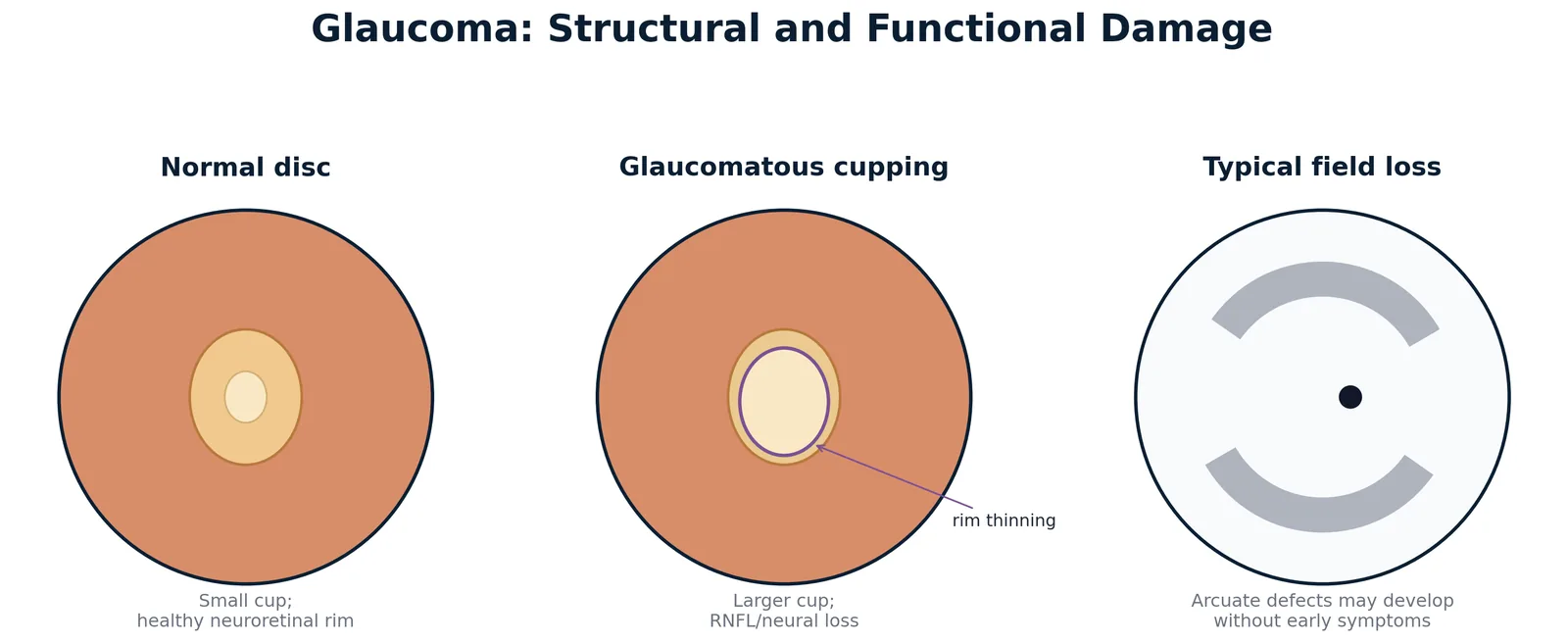
That study does not prove PDE-5 inhibitors prevent glaucoma either. The two studies involved different indications, populations, exposure definitions and follow-up, and both were retrospective. The scientifically correct conclusion in 2026 is that the glaucoma relationship remains unsettled. If you have glaucoma or ocular hypertension, keep your usual glaucoma visits; the 2026 tadalafil study alone is not a reason to stop a prescribed medication.
What about retinal detachment or retinal vascular occlusion?
A 2022 JAMA Ophthalmology insurance-claims study of 213,033 men receiving PDE-5 inhibitors reported associations with a composite of serous retinal detachment, retinal vascular occlusion and ischemic optic neuropathy. The composite incidence was 15.5 per 10,000 person-years, with an adjusted incidence-rate ratio of 1.85. Individually, serous retinal detachment (incidence-rate ratio 2.58, 95% CI 1.55–4.30) and ischemic optic neuropathy (2.02, 95% CI 1.14–3.58) were elevated in that analysis. The retinal vascular occlusion estimate was 1.44, with a 95% confidence interval of 0.98–2.12 that crossed 1.0. Our retina and vitreous pages explain these conditions.
Ischemic optic neuropathy
Sudden painless optic-nerve vision loss (NAION is the most common form).
Serous retinal detachment
Fluid separates the light-sensing retina from the tissue beneath it.
Retinal vascular occlusion
A blocked retinal vein or artery, which can cause sudden vision loss.
These are reported associations from observational data; causation is not proven, and absolute event rates are low.
Who should discuss eye risk before or during treatment?
- Anyone with previous NAION, particularly when considering continued or new PDE-5 therapy.
- Patients with substantial vascular risk factors or untreated obstructive sleep apnea.
- Patients with glaucoma or ocular hypertension, who should stay current with their normal glaucoma surveillance; the 2026 tadalafil study alone is not a reason to discontinue therapy.
- Patients with hereditary retinal degenerations such as retinitis pigmentosa: tadalafil clinical trials excluded such patients, and current Cialis labeling does not recommend use in known hereditary degenerative retinal disorders.
When should you seek urgent eye care?
The bottom line
For most patients, the familiar visual effect of sildenafil is a temporary color or brightness disturbance rather than permanent damage. NAION is rare but serious enough to warrant a clear emergency warning. The new 2026 glaucoma evidence is conflicting and does not establish that tadalafil causes glaucoma. Patients should make medication decisions with their prescribing clinician and their eye physician rather than from a headline.
Frequently asked questions
01Does Cialis cause glaucoma?
It has not been proven. A 2026 cohort of tadalafil users treated for lower urinary tract symptoms found a modest association with glaucoma, but a separate 2026 cohort of men with erectile dysfunction and chronic PDE-5 inhibitor use found lower glaucoma rates. Both were retrospective studies, so neither establishes causality.
02What does the “22% higher glaucoma risk” from Cialis mean?
It refers to a hazard ratio of 1.22 in one observational study. The actual five-year cumulative incidence was 3.93% in tadalafil users and 3.16% in matched non-users — an absolute difference of 0.77 percentage points.
03Why does Viagra sometimes cause blue vision?
Sildenafil can partially inhibit retinal PDE-6, temporarily changing blue-green color discrimination and sometimes causing light sensitivity or blur. The effect is dose-related and generally transient.
04Can Cialis or Viagra cause permanent vision loss?
Rare cases of NAION have been reported in temporal association with PDE-5 inhibitors, and product labeling warns patients about sudden vision loss. The exact causal contribution of the drug is difficult to separate from underlying vascular risk factors.
05What should I do if I suddenly lose vision after taking Viagra or Cialis?
Stop the PDE-5 inhibitor and seek urgent medical and ophthalmic evaluation. Sudden vision loss can have several serious causes and should not be watched at home.
06Is Cialis safer for color vision than Viagra?
Color-vision changes are much less common with tadalafil. Tadalafil labeling reports them in fewer than 0.1% of patients across its clinical studies, whereas sildenafil has a clear dose-related abnormal-vision effect.
07Should I stop Cialis if I have glaucoma?
Not solely because of the 2026 observational study. Discuss your glaucoma severity, eye pressure, optic nerve, other risks and the medication’s benefits with your physicians, and keep appropriate glaucoma follow-up.
08Do PDE-5 inhibitors cause retinal detachment or retinal vein occlusion?
Some observational studies have reported associations with serous retinal detachment and retinal or optic-nerve vascular events, but causality has not been established, and other datasets have produced conflicting results.
The May Eye Care Center & Associates is in Hanover, Pennsylvania, in York County, and sees patients from York County, PA, Adams County, PA, and Carroll County, MD and the surrounding region. If you have glaucoma or ocular hypertension and take one of these medications, your regular glaucoma visit is the right place to ask about it; if you have had NAION before, raise it with your eye doctor and your prescriber. Call (717) 637-1919 to schedule, or see the driving distances from towns across the region.
Sources
Primary trials, systematic reviews and meta-analyses, regulators, and current U.S. prescribing information are prioritized. Product labels change; each label was read on DailyMed on October 4, 2026.
- Hsia Y, Tsai CY, Hung SC, et al. Risk of glaucoma among patients using tadalafil for lower urinary tract symptoms: a multinational cohort study. Br J Ophthalmol. Published online August 4, 2026. doi:10.1136/bjo-2026-329957. PMID 42552102. pubmed.ncbi.nlm.nih.gov/42552102 (opens in a new tab)
- Elhusseiny AM, Abboud I, Almobayed A, Medeiros FA. Association between PDE-5 inhibitor therapy and the hazard of open-angle glaucoma. Am J Ophthalmol. 2026;288:33-40. doi:10.1016/j.ajo.2026.04.009. PMID 41974319. pubmed.ncbi.nlm.nih.gov/41974319 (opens in a new tab)
- Etminan M, Sodhi M, Mikelberg FS, Maberley D. Risk of ocular adverse events associated with use of phosphodiesterase 5 inhibitors in men in the US. JAMA Ophthalmol. 2022;140(5):480-484. doi:10.1001/jamaophthalmol.2022.0663. PMID 35389459. pubmed.ncbi.nlm.nih.gov/35389459 (opens in a new tab)
- Liu B, Zhu L, Zhong J, Zeng G, Deng T. The association between phosphodiesterase type 5 inhibitor use and risk of non-arteritic anterior ischemic optic neuropathy: a systematic review and meta-analysis. Sex Med. 2018;6(3):185-192. doi:10.1016/j.esxm.2018.03.001. PMID 29884471. pubmed.ncbi.nlm.nih.gov/29884471 (opens in a new tab)
- Belladelli F, Li S, Zhang CA, et al. Use of phosphodiesterase 5 inhibitors is not associated with ocular adverse events. J Sex Med. 2023;20(12):1399-1406. doi:10.1093/jsxmed/qdad137. PMID 37861186. pubmed.ncbi.nlm.nih.gov/37861186 (opens in a new tab)
- Elhusseiny AM, Swaminathan SS. Phosphodiesterase type-5 inhibitors and glaucoma. Int Ophthalmol Clin. 2026;66(3):1-7. doi:10.1097/IIO.0000000000000630. PMID 42312609. pubmed.ncbi.nlm.nih.gov/42312609 (opens in a new tab)
- Cialis (tadalafil) tablets. Current U.S. prescribing information, Warnings and Precautions 5.4 (sudden loss of vision, NAION, prior NAION, “crowded” optic disc, hereditary degenerative retinal disorders) and Adverse Reactions 6.1 (changes in color vision, <0.1%). DailyMed, U.S. National Library of Medicine. dailymed.nlm.nih.gov/dailymed/drugInfo.cfm?setid=bcd8f8ab-81a2-4891-83db-24a0b0e25895 (opens in a new tab)
- Viagra (sildenafil citrate) tablets. Current U.S. prescribing information, Warnings and Precautions (effects on the eye, NAION) and Adverse Reactions, Table 1 (abnormal vision by dose in fixed-dose studies). DailyMed. dailymed.nlm.nih.gov/dailymed/drugInfo.cfm?setid=0b0be196-0c62-461c-94f4-9a35339b4501 (opens in a new tab)
This page is general patient education published by The May Eye Care Center & Associates and is not a substitute for a medical examination, diagnosis, or treatment. Medication decisions belong with you and the clinicians who prescribe and monitor your care. In an emergency, call 911.
Ready to see
the world clearly?
Questions about a medication and your eyes? Bring your medication list to your next visit, or call to schedule an evaluation with our physicians. We coordinate with the clinician who prescribes your medication.
Contact the practice
Hanover, PA 17331